Money Market Funds vs Money Market Instruments: Which Is Better for Short-Term Cash Management?
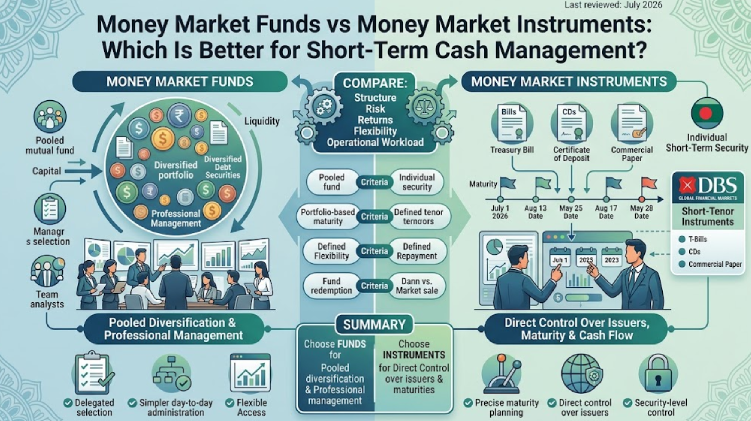
Businesses managing surplus cash must balance access, capital preservation, returns, and treasury controls. According to the US Securities and Exchange Commission’s 2024 Investor Bulletin, “money market funds are a type of mutual fund that invest in liquid, short-term debt securities, cash and cash equivalents.” By contrast, money market instruments are individual securities, such as Treasury bills, certificates of deposit, and commercial paper, that organisations may purchase directly.
This distinction shapes short-term cash management decisions. Funds may provide professional management and diversification, while direct instruments give treasury teams greater control over issuers, maturity dates, and cash-flow timing. Both options require scrutiny of liquidity, credit risk, fees, and settlement terms.
DBS Global Financial Markets provides short-tenor instruments of less than one year, including Treasury bills, certificates of deposit, and commercial paper, for businesses reviewing liquidity and surplus-cash options. The decision therefore turns on structure, risk, returns, flexibility, and operational workload.
Quick Summary
- Choose a money market fund when the priority is pooled diversification, professional management, and simpler day-to-day administration.
- Choose money market instruments when the treasury team needs direct control over issuers, maturity dates, and cash-flow timing.
- The main difference is structural. A fund is a managed investment vehicle, while an instrument is an individual short-term security.
- Neither option is automatically risk-free or suitable for operational cash. Businesses should assess liquidity, credit exposure, fees, settlement terms, and internal treasury capacity before deciding.
Should You Choose Money Market Funds or Money Market Instruments?
Neither option is universally better. A money market fund may suit businesses seeking pooled diversification, professional management, and simpler administration. Direct money market instruments may be more appropriate when treasury teams need control over issuers, maturity dates, and cash-flow timing.
- Best for straightforward diversification: Money market funds
- Best for planned maturity matching: Money market instruments
- Best for lean treasury teams: Money market funds
- Best for security-level control: Money market instruments
The main trade-off is convenience versus control. Businesses should compare liquidity, credit exposure, fees, settlement terms, and internal governance before making a short-term cash management decision. DBS Global Financial Markets offers short-tenor instruments, including Treasury bills, certificates of deposit, and commercial paper.
Compare Money Market Funds and Money Market Instruments
| Criteria | Money market funds | Money market instruments |
| Structure | Pooled fund | Individual security |
| Maturity | Portfolio-based | Defined for each security |
| Diversification | Built into the portfolio | Investor-created |
| Liquidity | Fund redemption terms | Maturity or market sale |
| Control | Manager-selected holdings | Direct issuer and tenor selection |
| Costs | Fund fees | Instrument-specific charges |
| Best for | Simpler diversified access | Precise maturity planning |
6 Differences Between Money Market Funds and Instruments
- Ownership: Fund units versus individual securities
- Diversification: Manager-built portfolio versus treasury-selected holdings
- Maturity: Portfolio-based liquidity versus defined instrument tenors
- Control: Delegated decisions versus direct issuer and maturity selection
- Costs: Fund expenses versus transaction, custody, and administration costs
- Workload: Professional management versus internal monitoring and reinvestment
Comprehensive Breakdown of Money Market Funds and Instruments
Structure and Investment Approach
A money market fund pools capital across liquid, short-term debt securities, cash, and cash equivalents under a manager’s mandate. Direct money market instruments involve buying individual securities, such as Treasury bills, certificates of deposit, or commercial paper. Funds delegate portfolio construction, while direct investing places selection and monitoring with the treasury team.
Better suited to: Funds for delegated management, and instruments for customised portfolios.
Liquidity and Maturity
Fund access depends on dealing, redemption, and settlement terms. Individual instruments have stated tenors and repayment dates, although selling before maturity may depend on market conditions. DBS Global Financial Markets offers short-tenor instruments of less than one year, which can help match investments with forecast cash requirements.
Better suited to: Funds for flexible access, and instruments for planned cash-flow dates.
Diversification and Credit Exposure
A fund may spread exposure across several issuers, maturities, and security types. A direct portfolio can also diversify, but the business must buy and monitor enough instruments. Diversification can reduce concentration, but it does not remove credit, liquidity, or market risk.
Better suited to: Funds for convenient diversification, and instruments for targeted issuer exposure.
Returns, Pricing, and Fees
The SEC states that money market fund yields generally follow short-term interest rates. Direct instrument returns depend on purchase price, maturity, issuer credit quality, and market rates. Fund expenses, transaction charges, and custody costs can all reduce net returns.
Better suited to: The option with the stronger risk-adjusted return after costs.
Control, Governance, and Treasury Workload
Funds place security selection and monitoring with a professional manager, subject to the fund mandate. Direct investing gives businesses control over issuer, currency, tenor, and maturity, but requires internal credit assessment, approvals, settlement, custody, and reinvestment.
Better suited to: Funds for operational simplicity, and instruments for security-level control.
Suitability for Cash Forecasting
Direct instruments can support known payment dates when maturities match expected liabilities. Funds may suit less predictable cash needs, subject to redemption terms. Neither option should automatically replace immediately accessible cash needed for payroll, suppliers, or other operating expenses.
Better suited to: Instruments for scheduled liabilities, and funds for less predictable liquidity needs.
Which Option Is Best for Your Cash Management Needs?
A money market fund may suit organisations seeking diversified exposure to liquid, short-term debt securities without selecting each holding directly. Direct money market instruments may suit treasury teams that need greater control over issuers, tenors, and maturity dates. The US Securities and Exchange Commission notes that money market funds invest in liquid, short-term debt, cash, and cash equivalents.
- For pooled diversification: Consider a money market fund, subject to its mandate, fees, redemption terms, and risks.
- For known payment dates: Direct instruments can align maturities with forecast liabilities.
- For limited treasury resources: A managed fund may reduce security-selection and reinvestment work.
- For strict investment limits: Direct instruments provide greater control over credit exposure, currency, and tenor.
DBS Global Financial Markets offers short-tenor instruments that businesses can assess against liquidity policies and cash-flow forecasts.
Frequently Asked Questions
Are money market funds the same as money market instruments?
According to the SEC’s 2024 Investor Bulletin, a money market fund is a pooled mutual fund, while money market instruments are individual short-term securities.
What instruments can a money market fund hold?
The SEC says holdings may include government securities, commercial paper, certificates of deposit, cash, and cash equivalents, depending on the fund type.
Are money market funds guaranteed?
No. According to MoneySense, Singapore’s national financial education programme, “every investment bears risk. In some cases, you could lose some or all of the money you invested.” A money market fund should therefore not be presented as guaranteed or risk-free, and businesses should review its prospectus, risk disclosures, and redemption terms before investing.
Which option offers better liquidity?
Liquidity depends on the fund’s redemption terms, or the instrument’s maturity and secondary-market conditions.
Which option is better for corporate treasury teams?
Funds may suit teams seeking diversification and simpler administration, while direct instruments may suit businesses requiring issuer and maturity control. DBS offers short-tenor Treasury bills, certificates of deposit, and commercial paper.
Match Your Investment Approach to Your Cash Flow Needs
The right choice depends on liquidity needs, cash-flow visibility, risk limits, and internal treasury resources. A money market fund may offer simpler diversification, while direct money market instruments can provide greater control over issuers, tenors, and maturity dates.
Explore DBS Global Financial Markets’ short-term money market instruments to assess options that align with your organisation’s liquidity strategy.